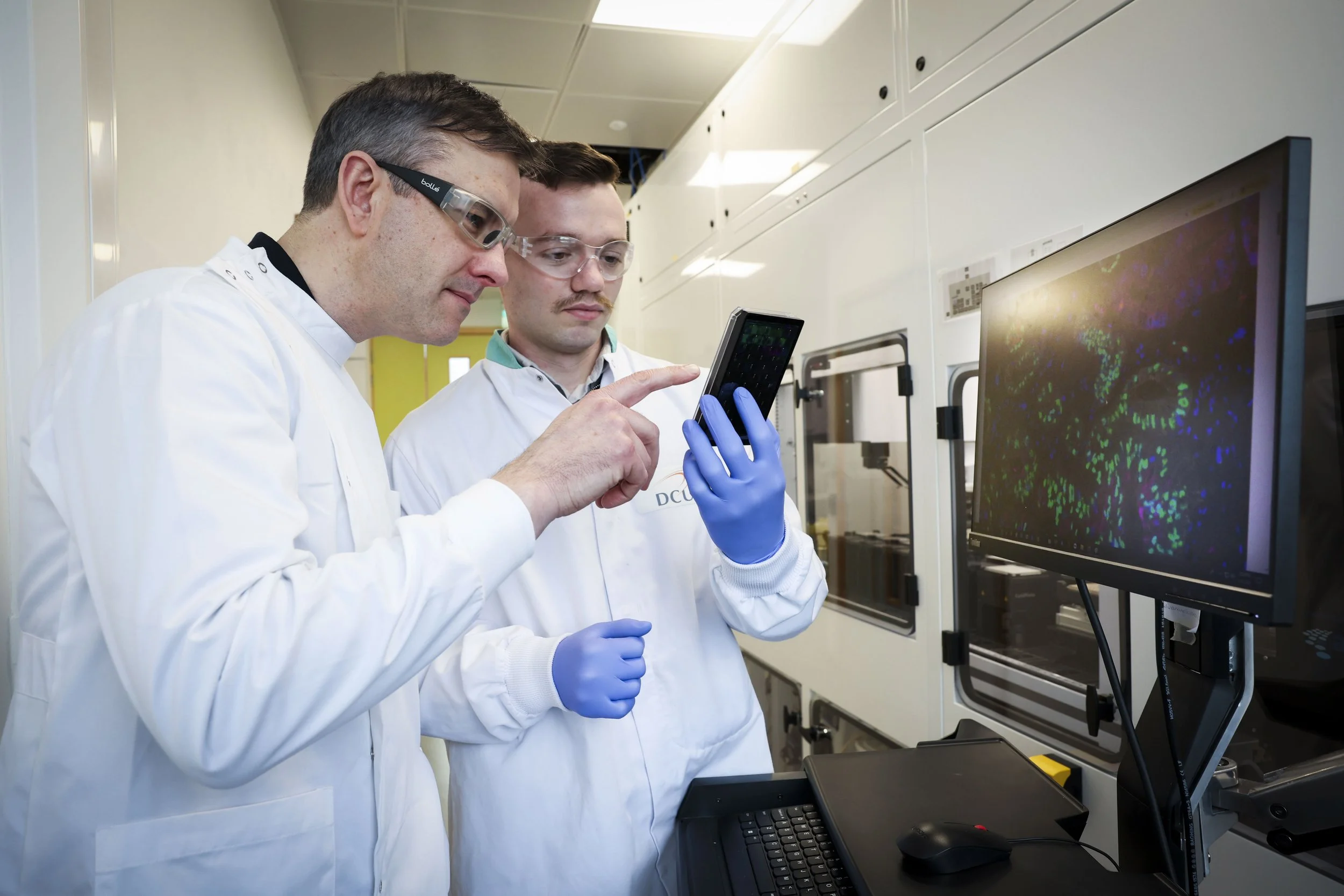
Our group at Dublin City University (DCU, Ireland), working with colleagues at Chimie ParisTech – PSL (France), Chalmers University of Technology and Sahlgrenska University Hospital (Gothenburg, Sweden), and the University of Limerick (Ireland), has developed a new chemical strategy for designing metal-based compounds capable of damaging cancer cell DNA. This approach may open up a new direction for future anticancer drug development.
Cancer chemotherapy has relied heavily on DNA-targeting drugs for decades. Platinum agents such as cisplatin remain clinical mainstays, but resistance and dose-limiting side effects continue to pose major challenges. Many tumours evolve ways to repair the specific types of DNA damage caused by these drugs or reduce drug accumulation inside the cell.
In our recent study, we explored whether a fundamentally different chemical design strategy could help address this problem.
Building DNA-damaging agents using click chemistry
We used click chemistry—a fast, modular and highly reliable way of assembling molecules—to construct a new family of compounds known as Tri-Click ligands. When coordinated with copper ions, these ligands form artificial metallo-nucleases: metal-containing agents specifically designed to cleave DNA.
Click chemistry has transformed many areas of chemical biology, but its potential as a platform for assembling DNA-damaging chemotherapeutic scaffolds remains under-explored. By exploiting its modularity, we were able to systematically tune ligand structure and investigate how this affects metal binding, DNA recognition, and DNA cleavage activity.
Why this matters for drug resistance
One of the most significant problems in oncology is multidrug resistance. Tumours can adapt to survive conventional therapies by enhancing DNA repair pathways or altering drug transport mechanisms.
The key advantage of our design strategy is that these copper complexes damage DNA through mechanisms that differ from those used by many current chemotherapy agents. By targeting DNA in new ways, such compounds may help circumvent some of the resistance pathways that limit the effectiveness of existing treatments.
A European collaborative effort
This project brought together complementary expertise in synthetic chemistry, molecular modelling, DNA biophysics, and cancer biology. The collaboration involved teams at:
Chimie ParisTech – PSL
Chalmers University of Technology
Sahlgrenska University Hospital
University of Limerick
Dublin City University
The integration of experimental design with molecular modelling and advanced DNA analysis was central to developing and evaluating this new class of compounds.
Early-stage but promising
It is important to emphasise that this work is preclinical. These compounds are early-stage research candidates and significant additional testing will be required before any potential clinical application.
Nonetheless, the study provides a new conceptual framework for using click chemistry as a platform to assemble structurally defined, DNA-damaging metal complexes. We believe this strategy could contribute to the longer-term development of next-generation anticancer agents that operate through distinct and potentially resistance-avoiding mechanisms.
The full paper is available in Nature Communications:
https://www.nature.com/articles/s41467-026-68911-5
